A Conversation with Dilara Miller
A Conversation with Dilara Miller
By Cora Secore
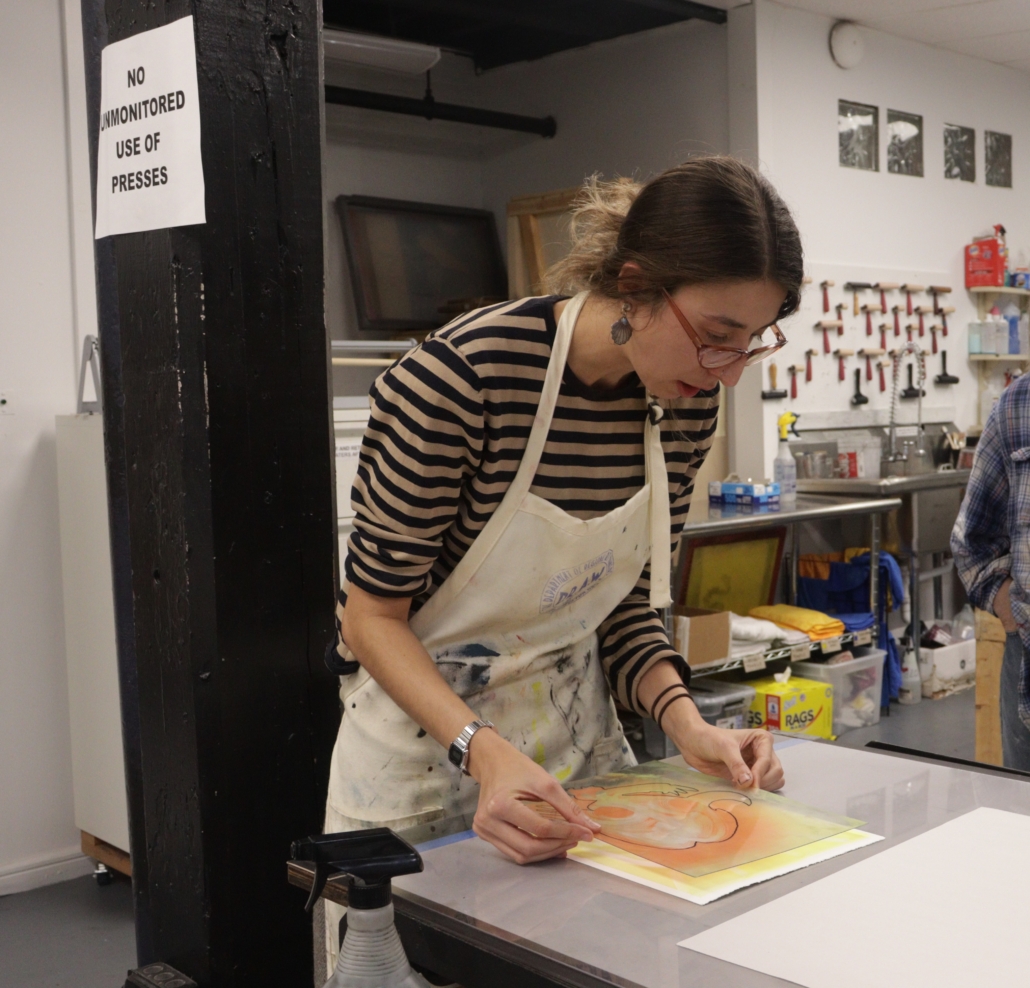
On June 24th, I interviewed Dilara Miller at the Neighborhood Print Studio where she works as the Studio Director. Dilara is a Muslim woman from Tȕrkiye who had the opportunity to discover the arts scene here in Kingston as a total outsider. Dilara first fell in love with MKAD and its programs through the Steamroller Print Fest and the way people had come together to celebrate it. Throughout her approach to life and art, Dilara has practiced constant curiosity and seems so joyful at all that she gets to experience here. It made for a particularly positive interview.
“I moved to the US about ten years ago,” Dilara said in regards to her introduction, “To pursue my BFA in printmaking at the University of Colorado Boulder. Then I pursued my MFA at Northern Illinois University, with an emphasis in printmaking and ceramics. I came to the Hudson Valley because I had family here, and the way I found out about MKAD is through the steamroller event! I volunteered at the steamroller event and got really connected with the community here and I wanted to be more involved. I was a teaching artist here for a year, then later on I became the director here! So, it’s been really exciting working with artists in the community and it’s a passion of mine collaborating with artists, creating programming, and bringing diverse representations to the community here.”
“This place is special compared to other studios I’ve been to,” Dilara went on, “The Youth Workforce here is inspiring. Myself, I didn’t get into arts without the possibility of a free government program in Tȕrkiye, that’s how I found art. Without accessible art education, I would not be an artist. I think the youth, and investing the time to build opportunities for them, to get them trained in printmaking is a very collaborative skill on its own. And introducing them to artists they connect with is so valuable! Because it creates an opportunity for an artist to visualize a future for themselves in the arts, while if you don’t have representation then you can’t visualize that. When I was in school I started learning more about muslim artists or Middle-Eastern artists.They made me realize, ‘I can tell my story and be welcomed!’”
I knew Dilara had also met countless artists through MKAD. “I’ve met so many artists in this area that are doing really exciting things,” Dilara said with glee, “All of the teaching artists that I work with are really amazing, and I think they bring an inclusive environment where anyone can come to our space and learn a new technique and connect with the community. That’s really important to me, that this space is welcoming to everyone. I’ve also met so many artists that are involved in bringing community, like working with Rewind Kingston and creating programming with them, working with Good Neighbor has been really exciting with Danielle there, and now working with the Steamroller Print Fest coming up where we’re bringing more artists in. Of course, all the members come in here to make work and I’m always looking to connect with more artists in this area. You’re always surrounded by artists, which I’m not used to coming from Tȕrkiye. [Dilara laughs] It was very hard to find artist circles, there were only small pockets of areas of them. And here it’s busting at the seams.”
I had learned a lot about Dilara’s creative practice from a prior interview, but it was important to me to catch up and refresh on what inspires her, especially if any part of it had evolved since then. “I think it’s always evolving but the basis of my work is always going to be philosophical,” Dilara told me, “Growing up I was a devout Muslim kid, and you’re exposed a lot to mortality and moral ideas and especially moral stories. I always felt that these were symbolic stories that have persisted through human history, and I think bringing them into a contemporary context and talking about women’s experiences in this world, a Muslim woman’s lens, talking about how these hierarchies in our stories reflect our views of other people and the natural world, is always really exciting for me to explore.
“And time, passing time is very interesting to me. Especially how everything feels infinite in this moment. But clearly we have relics of past civilizations, and those tell aching stories in their own that we refuse to face. So time is always present in my work, and I wanna have it more involved in my work. I want moments of collaboration and thinking about the passage of time. My new work has been taking a little break from the big ceramic tile assemblages. I’ve been making a series of watercolor paintings that are inspired directly by medieval Ottoman manuscripts, and then translating them into stories that are grounded in this time, then showing simultaneous times. So like, if there’s a big passage of time, they’re all on one page. Thinking about our future as climate collapse inches towards us, thinking about these stories like the Garden of Eden. Thinking about the garden and how it was walled out from us but in reality this garden is everywhere and we’ve created these walls and borders on our own. Always clashing with: What are these prescribed human notions, and how can we unravel them in these really familiar stories? That’s always a constant.
“I’ve been playing with documenting average day events as historical relics. I’ve been working on a series of scrolls in which I bring to events that has some kind of prompt and it documents that event. In Hagia Sophia, there’s one part where a viking carved onto the second story ‘Olag was here’ or something like that, [Dilara laughs] and I was like ‘That’s just so cool!’ We don’t think about that in the moment, so I wanted to document those forgettable times. We’ll see where it evolves, I’m constantly thinking about keeping it fresh. I think I’m always jumping between stories and always reading. Books always influence what I talk about. One Hundred Days of Solitude, East of Eden, the Overstory, these long stories across multiple generations always influence my work.”
Dilara and I got into a bit of a talk about moments of personal significance and encounters with nature that felt like omens in their own right. “I’m reminded of time, the cycles of death and rebirth,” Dilara spoke with inspiration, “They’re super important to me. I’m always thinking of that, it’s embedded in every system. Humans somehow created this detachment from ourselves, from this world of survival, to the social world that we play. I think it’s important to remember what systems we’re embedded in instead of thinking that we’re above them or separate from them. I think that’s done some damage to the human psyche! [Dilara laughs]”
I then asked Dilara what her definition of an artist is, which she gave much thought. “I think my definition of an artist would be someone who’s questioning and curious of the world,” Dilara said, “And is looking for an outlet to share parts of themselves that they might not even be aware of. I think art is a conduit of your internal emotional state, and I think that’s why it’s so healing for so many people who feel outcasted from their societies. It’s a safe place for them. I think, as an artist, if you’re continuously feeling an inclination to create art to share parts of yourself and are constantly inquiring, you’re an artist no matter what. [Dilara laughs]
“I think with the term artist, there are lines that we draw in the western world and it goes truly anywhere. When I was in Tȕrkiye I was going and seeing all these trucks that were ornately designed and thought, ‘That’s an artist,’ but that trucker wouldn’t call himself an artist. So it’s everywhere. I think it’s what makes us human, actually. You can see throughout history that we have always made art and we have always had the inclination to pour our souls into something. So, yeah, it’s a beautiful thing. [Dilara laughs]”
I wanted to know more about what art means to Dilara in a greater sense. “Not to be dramatic, but art totally transformed my life for the better,” Dilara spoke cheerfully, “I mean like, I truly had no purpose before I got into art really late. I think I started drawing when I was 19. I was quite lonely living in Tȕrkiye for the first time as a young woman. There were these things that I really wanted to process that was secretive for me and made me realize a lot of parts of myself that I wasn’t acknowledging. It was completely therapeutic, I can’t even express enough how much it changed my life. [Dilara laughs]
“Yeah, art saves lives, 100%. I think that’s why I’m so excited and passionate to work at this place, because I know as I’ve experienced it, how much art can flip your life. If you’re really struggling and you find an outlet to express yourself, especially when you’re a kid and you’re in a household where you can’t really express yourself, it’s a safe place to create in yourself. Art is magnificent. I’m so glad it exists and that we get to make it.”
Finally, I asked Dilara about her relationship with the community in Kingston, which I imagined would be an especially unique perspective with her status as an immigrant. I would come to find out how much excitement she had for this area. “I moved here 2 years ago,” Dilara said, “And the first thing I noticed when I got here was how welcoming everyone is, and how accessible everything is. I would get invited to studios, dinners, potlucks, exhibitions, and I would have a really exciting time connecting with those artists.
“I’ve been excited to get to know all of the artists here, more and more, like all the artists who work here, all the collaborations we’ve done at the studio. For example, working with Joe Gonzalez for Art Walk and Public School Teachers for educational programming, working with all the artists that come to our space and working through their imagination for their work. Even walking down to the Brush Factory or the T-Shirt Factory, checking out the open studios and connecting with the artists there. I’m always excited by the diversity of people in Kingston, especially here, that really excites me and makes it feel like home. I think that’s what drives me to this area. There’s always people hanging out on the streets, connecting with each other, and all of the places that I’ve visited here on Broadway, I’ve been able to go in so easily to connect with people. So to anyone who’s reading this interview: Come to me! [Dilara laughs] I want to get to know you!”
Dilara can be found on Instagram at @vishneli or on her website www.dilaramiller.com or reach out to her via email with dilara@mkad.art. She is currently open to collaborations and learning about people from all walks of life. With her bright beaming heart, full of excitement and compassion for the full breadth of the world around her, Dilara is the kind of artist we need right now. I hope you’ll keep up with her work for future shows and events.