A Conversation with Joseph Pine
A Conversation with Joseph Pine
By Colin Secore
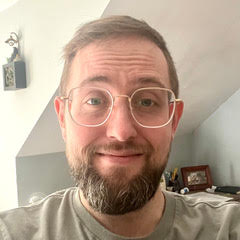
On June 15th, I met at The DRAW with Joseph Pine, an arts educator who’s taught the Drawing FUNdamentals class for middle school students here for years now. He has also started teaching classes for other art educators. Having worked with both kids and adults, he has a lot of experience with lifting up the artistic practices of various creatives in the area. Joe is a process-driven artist with determination to bring ideas to life.
“Everything I do is really about the making of an object or an image, and the associated textures and forms that come along with the making process,” Joe told me, “They’re really important to me.”
After I asked him more about his creative process, Joe said: “I am primarily a sculptor. My background is in metalsmithing. So most of the things that I make are out of copper. A lot is related to the table. So bowls, cups, spoonforms, and recently over the last couple of years I made a lot of works for hanging on the wall.”
I asked if Joe had any kind of connection to tables that brought him to this point. “No,” Joe replied, “It really comes down to process in metalsmithing. There are two traditional routes to take: Jewelry, or hollowware and functional objects. I wound up being more interested in functional objects and the associated forms, and most of the forms end up on the table. Things like candlesticks are really traditional in silversmithing. Bowls, urns, vases, coffee pots, things like that. I take those traditional forms and exploit them experimentally and visually to create something new.”
What does that experimentation look like, I wondered. “A lot of hammering,” Joe laughed, “So sometimes I take pieces and parts of familiar objects. I stretch them, distort them, make something that seems really familiar, really unfamiliar. One body of work that I did involved taking spoon forms and manipulating those. Like, spoons that are four or five feet long and really thin and flimsy. Some that weigh ten pounds, and can’t really be used functionally as a spoon. I’ve taken teapots and, rather than put on the spout so that it could pour, I’ll reverse the spout and have it dripping out from the side of the teapot.”
“I am interested in things that can tell a story,” Joe explained when I asked him what drove him down the path of functionality in sculpture, “And things that people can relate to in an everyday sense. So, a spoon for example, virtually every culture in the world has used a spoon. Every human being has used a spoon and knows what it’s like to take a spoon, full of food or liquid, to their mouth. Taking those standard expectations and distorting them is really interesting and exciting to me.”
I asked Joe, like I had with previous artists, what his definition of an artist was. “I would say being an artist is about experimentation,” Joe said, “And it’s about fun, and it’s about whimsy. I think if you aren’t enjoying making art, you might be doing something wrong. Playing with materials, engaging with media to create something that no one’s ever created before, and bringing something from your head to life. In terms of the whimsy, I think every artist should make something funny. At least once. If, for no other reason, just to get some frustration out.
“I was working on these repair pieces for a while where I was taking broken, damaged tableware goods like teapots and trying to fix them. I had this copper teapot sitting on my bench for a while and I couldn’t figure it out. It was really thin, cruddy, cheap, something mass-produced with basically flimsy copper foil. I was trying to straighten out a dent or something and got frustrated with it, so I just threw it across the room. A couple times. And stuck a fork in it as a handle and called it done. It was like a ‘good enough’ moment, like, I fixed it! So I think art should also be a way for artists to vent whatever emotions they’re having.”
I wanted to know more about Joe’s connection to MKAD, and I learned that his relationship with MKAD stems from its invention and was a major factor in his development as an artist. “I had Lara Giordano as a high school teacher way back in the day before she retired. I graduated Kingston High School in 2008 and I had Lara two years in a row. From the minute I had her as a teacher, I didn’t leave her room. I sort of credit her with pushing me beyond thinking of art as a hobby or something I did in the sides of my notebook. She pushed me to take it seriously, and so in my senior year of high school I was really lucky to be involved in her first senior seminar class where all the senior students got to work on these big projects. It was basically an intro to a college art class. It was really cool! It was really exciting for me as a 16, 17-year-old kid to get this experience of working with a teacher rather than making work for a teacher. I really credit her for changing my thinking about art and art education.
“I went on to get an undergraduate degree in Fine Arts. I continued to get a masters degree in art, and then eventually after Covid I moved back to the area, realized that what started out as my senior seminar class had blossomed into this beautiful huge organization, and I wanted a piece of it. I wanted to get involved and give a little bit back, and become a part of what made me an artist.”
Joe told me more about the ways MKAD has contributed back to him. “I can not be more thankful for the opportunity that The DRAW and MKAD has given me to work with so many students,” Joe said, “Not only the students that I’m directly teaching (the middle schoolers) but also being able to work with the Youth Workforce and watching them learn and grow. That’s really fulfilling for me. Being able to be, not to fluff my own stuff, somewhat of a role model for future generations who are where I was 15 years ago.
“I am Kingston, born and raised. My father’s side actually goes back to pre-America Kingston. It’s pretty Kingston! We’re pretty Kingston. [Joe laughs] So I love this area, I think it’s beautiful. I left for a couple years, moved to the midwest. I loved it out there but it’s not the same. People really underestimate how strong the greater arts community is in this area. I think people born and raised here don’t realize how privileged they are to be surrounded by so many great artworks and artists and a strong educational background in the arts as well, throughout all of the schools, public and private, even through the universities. New Paltz alone is highly regarded in multiple fine arts departments. It’s hard to find a better place to live as an artist. Price not withstanding. [Joe laughs]”
Joe’s work can be found at josephpinestudio.com. He was a pleasure to talk to, an artist who cares so deeply about the arts and their importance. Not only that, but also proud to be here while always keeping his finger on the pulse of how the local arts scene is playing out.