A Conversation with Pablo Shine
A Conversation with Pablo Shine
By Cora Secore
On Friday, October 30th, I met with teaching artist Pablo Shine at his studio on the outskirts of Kingston. I had interviewed him once before at that same place about a year ago when I was writing for Midtown Lively. Both times, he gave me delicious tea to drink. One thing that will be quickly known by anyone who meets him is that Pablo is a very gracious man. The contact he makes with his emotional soul informs his work as an artist and a teacher, which I hope to make abundantly clear through this article. Pablo has taught watercolor painting at all levels at The DRAW over the last few years and has made reliable contributions to the local arts community.
My conversation Pablo started off with the topic of what it’s like to teach and perform in the current economic climate, and the measures he takes to make his artistic practice work. “I can speak, being an adjunct for several years, I’ve always had to do something on the side because the money was never enough. In American culture, teachers are often not appreciated or well-paid. That’s just the way it is. I’m also a musician. I’ve had to really push to get well-paid gigs. And even if I don’t get paid, my band needs to get paid because without them, nothing happens. Sometimes we have a gig and it’s not enough money, so I think of it as publicity. I pay all the guys, sometimes there’s two, three, or four, depending on the performance. If I can get paid myself, that’s great! But sometimes I have to choose. And when I choose, I choose them. I have to honor their energy and their time that they put into rehearsal, which is something that people don’t see. A lot of people think that music just happens out of thin air. It really doesn’t, you have to work at it.
“I’m currently doing a class at The DRAW where we’re painting landscapes from photo references. It’s a practice that has been done for a long time, but I hadn’t seen anything like it at The DRAW. Painting the landscape on-site, en plein air, could be challenging. You have to carry equipment, or deal with the weather, or maybe it’s winter and you really don’t want to go outside. But if you have a good photo and you have a great system, you can still paint the landscape inside. You’re still practicing. But to put the class together is a lot of work! I have a setup here where I’m painting from a photograph and getting colors mixed, all so I can present it to my class. That’s my homework tonight. [Pablo laughs]”
I asked Pablo about what the relationship between him and his students was like, to which he emphasized the importance of accessibility. “I always try to make things very accessible,” He said, “That is a key word. To maintain myself as accessible to them, to be as clear as possible, to explain things as simply as possible, so that they can process that. There are teachers that talk in very technical terms and they talk fast and they don’t explain it well. I’d rather teach something slower, explain things well, and break it down with a demonstration for them. The reason I do the sample paintings is so they can see what they’re in for.
“This is my approach, but they may come with their own ideas, something that is a little more expressive. I don’t like stifling creativity. If someone wants to do something different from what I proposed, that’s okay. People have different personalities, they come from different paths of life. You can tell them, ‘This is what I have to offer and this is how I do it, but if you find a way that’s more comfortable for you, go ahead,’ I have no problem with that. Throughout my life, I’ve always tried to teach just so they don’t think: ‘He’s not gonna like this or that.’ It’s not about what I like. I can show you the steps on how to get to this, [Pablo gestures to his setup] but it’s up to you on how you want to do it.”
I wanted to know more about Pablo’s teaching experience, the extent to where and what else he taught. “At SUNY Ulster I taught acrylic painting and drawing. I was there for 22 years,” He explained, “Looking back at the early 70s, my father was my first teacher and he was an oil painter. I went to college in Puerto Rico and everything there was oil painting. Then I came here in ‘83 and all the teachers were teaching oil painting. Acrylic painting is maybe a thing that happened after I graduated from school in ‘88 with an MFA. I’ve seen exhibited work at SUNY New Paltz and some of the work is acrylic. I figure maybe the curriculum they have now is oil-based, and then water media to be more inclusive. Training students in a way that they can learn different mediums is a good thing.”
When I requested Pablo for some teaching wisdom for other teachers, he wistfully went, “Not really. I learned from many teachers, it didn’t just happen in a vacuum. My father was my first teacher and then I had a dozen teachers throughout my college life. I picked something up from each one of them. One thing that was clear to me, when I graduated from SUNY New Paltz, is that I wanted to create an environment that was welcoming for the students. That’s really important to me. In life, and in the classroom, I play classical music and do really down-to-earth demonstrations so that they’re comfortable. I think that when you’re comfortable, you feel welcome and have a better chance to learn something. You shouldn’t be stressed or freaked out because a teacher is so tough. That’s my take, and that’s what’s special about my particular style of teaching. Clear, simple, welcoming.
“When you try to learn new things, you feel kinda vulnerable, because you don’t know if that thing’s going to turn out or not. You are just trying that thing. That’s something to keep in mind for people who have never done an oil painting, or watercolors. You have to be kind because they are vulnerable, in a way. That’s something that’s needed, especially in the volatile culture we have right now. [Pablo laughs] It’s so crazy!”
I learned about how Pablo discovered MKAD and The DRAW, and it started with Lara Giordano, as many teaching artists share in how they learned of the organization. “I remember right after COVID, I had quit my job at SUNY Ulster and was taking some time to myself. I didn’t have to teach, I could paint houses and invest all my creative energy into my personal work. But I bumped into Lara Giordano a few times, and she always asked me: ‘When are you gonna come teach drawing, painting, whatever you want to teach?’ I told her, ‘No, no, I’m just doing my own work,’ until finally one time I bumped into her at Catskill Art Supply. She asked me again and I said ‘Yes, I’m ready for it.’ That’s how I started teaching watercolor classes at The DRAW.”
“One thing my mother taught me (She passed about a month and a half ago),” Pablo continued, reminded of her wisdom, “She’d tell me: ‘You need to be a service to your community somehow. If you’re not a service to your community, you’re in the wrong place.’ She was a great woman.” I could see how Pablo’s generosity had come about.
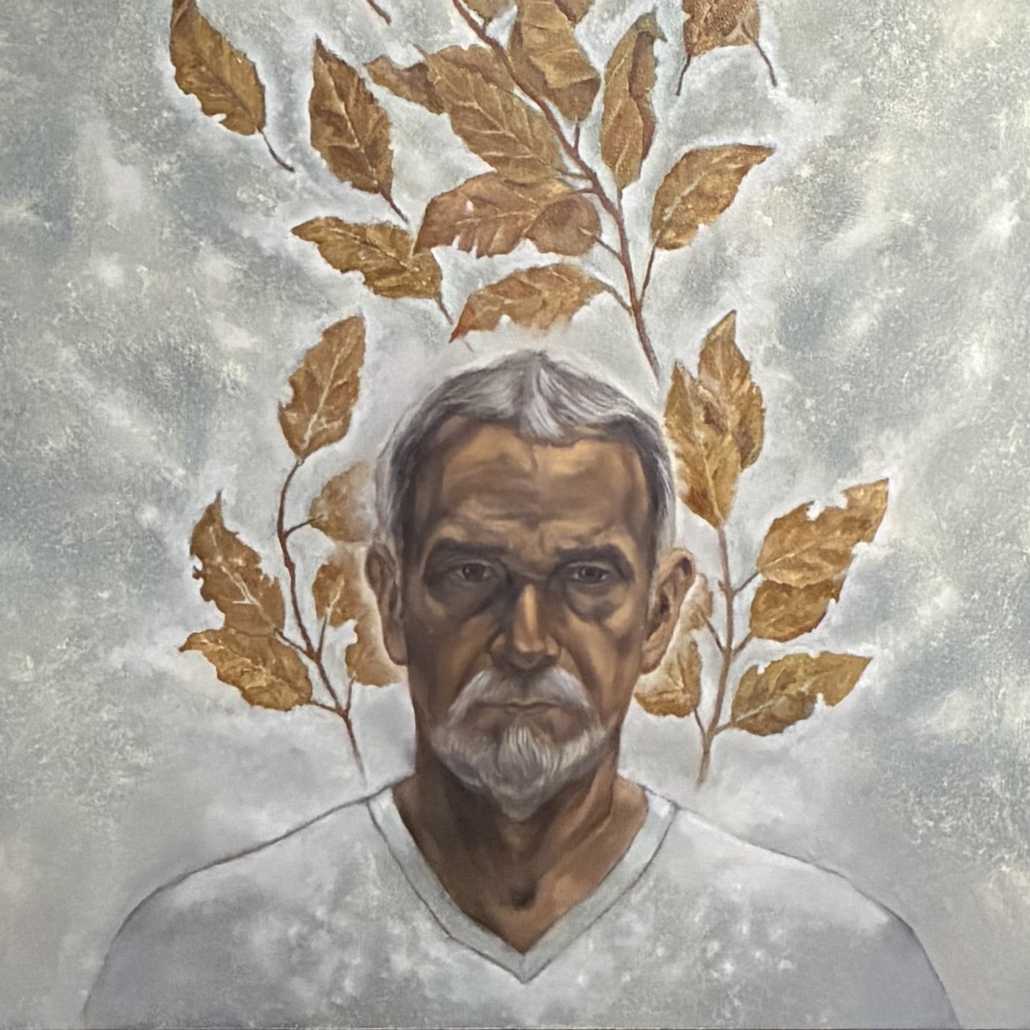
I asked Pablo about his creative practice recently. During our last interview, he had been heavily inspired by the African diaspora in Puerto Rico. Being in his studio, I could see that his focus had shifted greatly. Around me were still lifes and a self-portrait, all with ethereal backdrops and dreamlike compositions. He showed me through his recent work, and explained the throughline of memories between them. “At some point in your life, you become a vessel of memories,” Pablo expressed his thinking, “So many memories, some of them really gratifying, some not so great. But your head is like a container. The self-portrait (called Memory Carrier) was started before Pablo’s mother passed and will now be finished after she passed. So now it’s like I’m dedicating it to her.”
When I asked Pablo about a still life called Fading Memories, he said, “It’s about time, how time takes over the mind and how we forget certain things. A lot of events in our life are fading away with time. I can talk to you now about 55 years ago when I was 10, I remember so much about it. A lot is being lost over so many years. Certain key things hold on, they’re galvanized inside your mind. For me, meeting my wife, that’s galvanized in my mind because it’s one of the most important events in my life. That was 30 years ago. My mother’s passing and how I saw her in hospice, it was heartbreaking to look at her. Every now and then, that unlocks from my mind. I feel that it has made me stronger. I plan to do something with that energy. When making that painting, I was looking for an event in my life that really marked me. Sometimes for a push, you need something that really marks you to keep creating in your life. I think this, her passing, is something that really marked me.
“Returning to the idea of time, time is so ephemeral, so abstract. It’s hard to define time. I was reading a book about the physics of time, and there’s a beautiful passage that says: ‘When you’re born, you’re brought forth into this world by your mother. When you come out, you jump into a raft, and that raft is floating in the river of time. On your journey on that river that goes on forever, you see post signs of things that are happening in your life. When you pass, you jump off of that raft, but that river keeps going on forever.’ That’s time. It’s a subject that has been written about forever. You go back to the ancient Greek philosophers and even they wrote about time.”
It was then time for me to inquire on Pablo’s personal definition of an artist, a question that has become a highlight for me during these interviews. “You know, this could go many different ways,” Pablo replied, “Practical ways, or down-to-earth ways…But you know, I make things. I create things. A potter makes pots, a sculptor sculpts, a writer writes. They make things that go out into the world for people to see, buy, or both. When you really look at it, an artist is somebody who works with ideas. Everything starts there. You start with an idea and put it on paper and go from there, developing that idea. An artist also works with concepts, whether that is a still life, architecture, design, whatever. Art is about ideas. If you don’t have an idea, nothing happens.”
Finally, I wanted to hear more about Pablo’s perspective on how he serves his community. “I feel that through my teaching practice, I serve my community,” He said, “People come to my classes and we have direct exchanges. I show them how to do certain things and talk to them about different concepts in art. Hopefully, I share something I’ve been doing for a very long time with that person. In the classroom, 3 to 15 people get together to do art. By gathering those people and having them do art, I feel I am doing a service to the community. It’s a specific way of spending time. It’s peaceful, they are engaged, sometimes they talk to each other, and what happens in the classroom is like magic. I’ve had people who told me they haven’t looked at their phone in 2 hours, so that to me is like a freaking miracle! [Pablo laughs] If a person can totally put their attention on what they’re doing, I am giving them a gift and doing them a service. It’s good for the mind and soul. That is the way that I feel I best serve the community. I’ve done other community work in my life, but I always come back to teaching.”
With the end of the interview, I had finished my tea and we said our goodbyes. I found this interview especially moving and resonant with that which I hold dear. I’ve assisted in some of Pablo’s classes, so I can attest to the steadiness and calmness that he strives for. In a way, his demeanor parallels the medium of watercolor that he’s known for at The DRAW. He’s colorful and flexible, quiet and gentle. Pablo can be found on Instagram and Facebook, as well as his website pabloshine.com. Of course, you can also work directly with him through his painting classes which are consistently in circulation at The DRAW.